Symbiosis
Posted on 9 July 2010 | No responses
Rossetti acted as Lizzie’s teacher and mentor, but I do not feel that this aspect of their relationship was one-sided. I prefer to view their time together as one of collaboration and believe that they influenced each other in an artistic and symbiotic flow. A good example of this is Siddal’s painting Lady Affixing a Pennant and Rossetti’s painting Before the Battle. Both works have identical subjects, presented in a medieval style. In these paintings we see women attaching banners or pennants to knight’s spears in preparation for battle.

Lady Affixing a Pennant, Elizabeth Siddal circa 1856
Artist paints Ophelia using bacteria
Posted on 1 July 2010 | No responses
In a highly original and unique project, artist Jo Wonder recreates Ophelia by Sir John Everett Millais using bacteria as a medium. The video is incredibly moving and includes voice mails and messages left for Ophelia. “I like the idea of Ophelia being a beauty but made up of something that we think is disgusting. But we shouldn’t really be thinking it’s disgusting because in fact, roughly nine out of 10 cells in our body are actually bacteria and our bodies are also made up of roughly 60% water, as Ophelia lies in the lake dying she may be feeling fantastic as her body rejoins the earth.”
The section enclosed includes poems submitted by children, strangers and Kim Morrissey whose works often examine the role of women in nineteenth century culture.Bacillus Mycoides and other bacteria were used to depict Ophelia’s soul and breath in the animated painting.
Submit your own poetry/dedications to Ophelia by voice mail to complete this art installation.
Please participate in this project by leaving a poem to Ophelia on her voice mail at +44 (0) 2071839366 (standard land line Uk rates in the UK).
Related links: Under the Microscope
6 Days goodbye poems for Ophelia
Retired teacher pinpoints where Millais painted Ophelia
Posted on 30 June 2010 | No responses
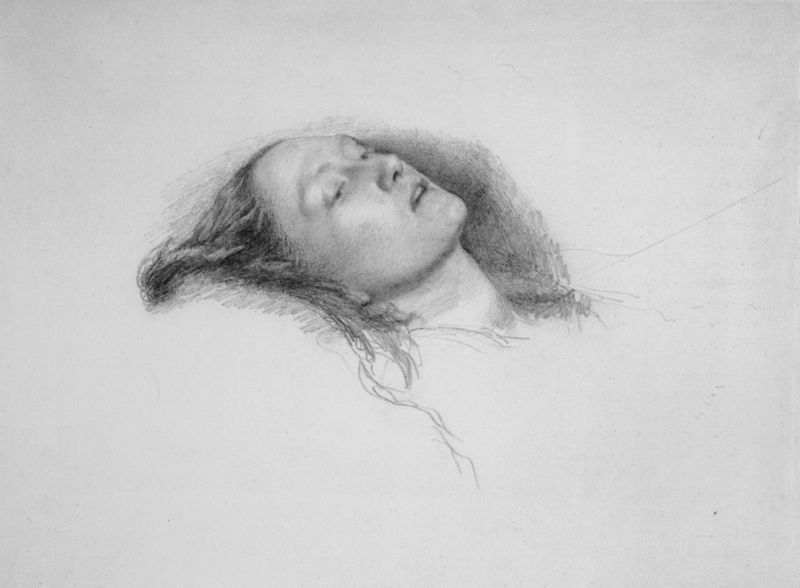
Barbara Webb has narrowed down the location where Millais sat to paint the background to Ophelia. Ophelia is not only one of the artist’s most famous works, it is also one of the most recognizable images of Elizabeth Siddal. Read the entire article at Telegraph.co.uk.

For more on Elizabeth Siddal as Ophelia, visit the Ophelia page.
W.M. Rossetti article from The Guardian Archives:
Posted on 24 June 2010 | No responses
Thank you to Cathy Baker of Gather Ye Rosebuds while ye may for bringing this to my attention.
Originally published in Manchester Guardian on 29 March 1904. William Michael Rossetti starts off with the intention of setting the record straight that John Ruskin did not “set Pre-Raphaelitism going”. Excerpt below, click here to read the entire article.
New article in the Spectator on Barbara Bodichon and her circle, including Elizabeth Siddal
Posted on 17 June 2010 | No responses
A new article in the Spectator explores Barbara Leigh Smith, later Bodichon. Written by Charlotte Moore, this charming piece introduces us to her ‘Aunt Barbara’, whose circle of friends included many famous Victorians. I recently saw the sketch that Barbara made of Elizabeth Siddal in The Art of the Pre-Raphaelites by Elizabeth Prettejohn. The sketch, currently owned by Mark Samuels Lasner, shows Lizzie posing with irises in her hair while Lizzie posed for Bodichon, Anna Mary Howitt, and Rossetti.
Via The Spectator, please click to read entire article:
Aunt Barbara’s fireplace:
Commemoration of Siddal and Rossetti’s marriage
Posted on 16 May 2010 | No responses
Via Hasting’s Art Forum: 150 years ago on May 23rd 1860 the Pre Raphaelite artists Dante Gabriel Rossetti married his lover and model Lizzie Siddal in St. Clements Church Hastings. Lizzie later became a fine artist and poet in her own right. Sadly just two years later she died. To commemorate the wedding there will be an exhibition by local artists in St Clements Church from 10.00am until 4.00pm daily from Sunday 23rd – Monday 31st May. Exhibiting artists include Ron Nicola, Jane Marriner, Mike Williams, Alan Wright, Simon Hookey, Bruce Williams and Beth Boorman. Exhibits include paintings, stained glass, photography and wood carving. Local children will also exhibit. The works of art already in the church will also be on display including the brasses (which are usually covered) and the Sanctuary Light given to commemorate the wedding. On the evening of Saturday May 22nd there will be a concert of song and prose inspired by the Pre Raphaelites given by Susannah Appleyard and members of the Hastings Arts Forum poetry group. On Sunday May 23rd there will be a sung evensong at 7.00pm to commemorate the anniversary itself. Sitters are also needed to look after the exhibition so we can keep it open all week. Contact Keith Leech on 01424 716576 or bogiekeef@tiscali.co.uk
[Keith Leech]
The Oval Portrait/Hand and Soul
Posted on 1 May 2010 | No responses
I thought I’d share what I’m currently reading and exploring in case any visitors to this site might like to join me.
I’ve been reading a very short story of Poe’s called The Oval Portrait (I’ve transcribed it here at LizzieSiddal.com if for those of you who have never read it). Rossetti was an admirer of Edgar Allan Poe’s work and drew several illustrations of Poe’s stories. The Oval Portrait is an interesting little tale of an artist’s model dying while her portrait is being painted. It is a concept that Rossetti would visit more than once in his own work–he had an incomplete story called St. Agnes of Intercession and a piece called Hand and Soul that appeared in The Germ.
The Rossetti Archive describes St. Agnes of Intersession:
The influence of Poe’s short stories, particularly the supernatural tales, is evident in this work, as it is in its famous companion piece Hand and Soul. But DGR decisively shifts the Poe model so that both tales become programmatic commentaries on art and its contemporary psychic and socio-cultural relations.
The hoaxing character of these tales is marked in this one in an especially arresting way. The Sterne epigraph is actually a spurious (pastiche) text. DGR clearly means it to function as an oblique signal to the discerning reader.
Special notice should be taken of the lyric embedded in the story. Written specifically for this tale, it stands in the work much as Stephen Daedalus’ famous “Are thou not weary of ardent ways” stands in Joyce’s Portrait of the Artist as a Young Man. Each poem is written partly as an index to the character of its fictive author—in this case, the character of the poet/critic being satirized by DGR in the story. Part of the wit of DGR’s poem lies in its parodic resemblance to certain features of DGR’s own poetical style. Self-parody is a form of pastiche that DGR, like Swinburne, liked to practice, and in this case it functions especially well. The story as a whole, for instance, is written under the parodic sign announced in the spurious epigraph from Sterne placed at the front of the tale.
The Keatsian facet of this self-parody is partly discernible in the general allusion to Keats’s famous narrative “The Eve of St. Agnes”, and partly in two witty lines in the poem imbedded in the tale, “O thou who art not as I am”. The words “purplehushed” (line 21) and “bloompulvered” (line 30) are Keatsian constructions (a fact slightly concealed when WMR published the poem and hyphenated both words, though they are not hyphenated by DGR). Other words and phrases in the poem—for example, “unipotence” (line 13) and “autumntide and aftermath” (line 22)—are clearly self-parodic of DGR’s own Keatsian-influenced style.
Today I’ve decided to read Rossetti’s Hand and Soul, found via Google Book Search.
The Legend of Elizabeth Siddal to be republished
Posted on 12 April 2010 | No responses
The Legend of Elizabeth Siddal by Jan Marsh is set to be back in print! The book will be available from the publisher, Quartet Books, in May. This book has become a sought after item for many Siddal enthusiasts, often garnering high prices on eBay and other online book sellers.
Mentions of Lizzie in Rossetti’s letters to his family:
Posted on 1 April 2010 | No responses
A full textual transcription of Rossetti’s family letters can be found at The Rossetti Archive. For the purposes of this post, I have only selected letters that mention Elizabeth Siddal in an effort to see how Gabriel communicated with his family in regards to his relationship with her. Taken from Dante Gabriel Rossetti. His Family-Letters with a Memoir (Volume Two)
The first letter is prefaced with a description by William Michael Rosseti:
“The Sid,” first mentioned in this letter, and more frequently afterwards under her name Lizzy, was Elizabeth Eleanor Siddal.My brother’s things sent “from Highgate” must have been forwarded, I think, from a house rented by Mr. Bateman, a decorative artist, who had emigrated to Australia with Mr. Woolner and others. Mrs. and Miss Howitt (the late Mrs. Howitt-Watts) were then staying in the house, and were on very cordial terms both with my brother and with Miss Siddal. My brother’s proposed trip to Hastings was for the purpose of rejoining Miss Siddal, who stayed there on various occasions for health’s sake.”[London.4 August 1852.]
My Dear Christina,Maria has just shown me a letter of yours by which I find that you have been perpetrating portraits of some kind. If you answer this note, will you enclose a specimen, as I should like to see some of your handiwork? You must take care however not to rival the Sid, but keep within respectful limits. Since you went away, I have had sent me, among my things from Highgate, a lock of hair shorn from the beloved head of that dear, and radiant as the tresses of Aurora, a sight of which may perhaps dazzle you on your return. . . .
I am rejoiced to hear of your improved health, and hope it may prove lasting. I was lately in company with Mrs. and Miss Howitt, with whom you are a considerable topic. I believe Mamma forwarded you an intelligent Magazine by Mrs. H[owitt] to which you are at liberty to contribute. That lady was much delighted with your printed performances, and wishes greatly to know you. Her daughter . . . has by her, singularly enough, a drawing which she calls The End of the Pilgrimage , made by her some years back, which furnishes an exact illustration of your Ruined Cross.
On the opposite page is an attempt to record, though faintly, that privileged period of your life during which you have sat at the feet of one for whom the ages have probably been waiting. The cartoon has that vagueness which attends all true poetry. On his countenance is a calm serenity, unchangeable, unmistakable. In yours I think I read awe, mingled however with something of that noble pride which even the companionship of greatness has been known to bestow. Are you here transcribing from his very lips the title-deeds of his immortality, or rather perpetuating by a sister art the aspect of that brow where Poetry has set-up her throne? I know not. The expression of Shakespear’s genial features is also perhaps ambiguous, though doubtless not to him. Westminster Abbey, I see, looms in the distance, though with rather an airy character.
I shall very possibly be going to Hastings in a few days. Meanwhile, till I hear from you or see you again, believe me, dear Christina,
Your affectionate Brother,
D. G. Rossetti.I forgot to say that Mamma considers 2 s. 6 d. sufficient to give the maid—in which, I may add, I do not coincide. Mamma however says you must judge.
In this letter Gabriel writes to his brother and is appears eager to facilitate a friendship between Lizzie and his sister, poet Christina Rossetti:
14 Chatham Place.
Tuesday [28 March 1854].
My Dear William,Tell Christina that, if she will come here on Thursday, Lizzy will be here. . . . I shall be glad if she will come, as I have told Lizzy she mentioned her wish to do so.
Allingham has been looking over her poems, and is delighted with many of them. I am going to lend them him (trusting in her permission to do so), that he may give his opinion as to which will be the best for the volume. Lizzy will illustrate, and I have no doubt we shall get a publisher.
In this letter, Gabriel writes of Lizzie to his mother. He discusses Lizzie’s health with ease and familiarity. This was written during their stay in Hastings:
( My address will be) 5 High Street, Hastings.
[ May 1854].
My Dear Mamma,I found Lizzie apparently rather better than otherwise; at any rate not worse, either by her own account or by appearances. Some of her bad symptoms are certainly abating, and her spirits, she says, are much better. I have been staying at the Inn here; but move to-day to Mrs. Elphick’s, 5 High Street, where Guggum is, and where my lodging will cost 8 s., I believe. Barbara Smith and Anna Mary came down to see Lizzie yesterday from Robertsbridge, some miles from here, where they are staying; and we all took a walk together, which did not seem to fatigue Lizzie much. There are several other ladies who have been most attentive to Lizzie, and every one adores the dear. No one thinks it at all odd my going into the Gug’s room to sit there; and Barbara Smith said to the landlady how unadvisable it would be for her to sit with me in a room without fire.
I wrote yesterday, from her own lips, a most minute account of her state to Wilkinson, and expect his reply. I cannot think that there is any need of her going into the Sussex Infirmary as proposed.
She and I are going to Robertsbridge to-morrow to spend the day. The weather has turned, and become most delicious. The sea to-day looks like enamel in the sun, and there is a cool breeze. I write this waiting for breakfast at 8 a.m. (!) Yesterday I saw the sun rise !!! over the sea—the most wonderful of earthly sights. This morning I was awake
in time too; but there was less beauty in the dawn, though the day promises to be even more lovely than yesterday.
But I fear you cannot even yet be much in a mood for hearing of these things. I myself feel more at ease since seeing Lizzie, but nevertheless was not the merriest of our party yesterday.
Bye-bye, Bunk. Love to all.
Your most affectionate Son,
D. G. Rossetti.P.S.—Perhaps I may be bothering William before long to send some painting-things from my rooms, but am not sure how long I stay. Will he go round and see if Ruskin’s books have reached there for me, and will you let me know if you write?
Rossetti writes to his brother William, seemingly just a few days later. The “Barbara” and “Anna Mary mentioned are Barabara Smith Bodichon and Anna Mary Howitt.
5 High Street, Hastings.
Thursday [11 May 1854].
MY Dear William,I wish you would tell people I am not dead, but by no means encouraging the idea of such an amount of life as at all facilitates human intercourse. It is rather slow here, and generally very windy, though often glorious sunlight. Tell Allingham if you see him that, should he have an idea of coming to Hastings, I wish he would carry it out; andthat, if he can only spare a day or so, his best plan would be to take a return ticket on Saturday, which costs £1 (second class), and will bring him back by the last train on Monday. Or if you could do this yourself, do. I want to know something of all things—how do people talk of Hunt’s pictures? I saw Ruskin’s letter. Had the Times been cheeky? How is Collins hung? And is there anything worth description in the R. A.? I suppose you have begun in the Spec . If you could send me that public organ I should be thankful.Lizzy seems upon the whole a little better, and Wilkinson judges so from the long account of her symptoms which we sent. She and I spent a pleasant day on Monday at Scalands, where Barbara and Anna Mary have been staying. They made themselves very jolly, and it is a most stunning country there. I heard from MacCrac, who offers £50 for the water-colour, with all manner of soap and sawder into the bargain—a princely style of thing.
There seem to be several places tolerably within range hereabouts which we ought to see, and shall set about seeing; but Lizzy is not capable of too much exertion. I dare say I shall very soon be boring you to send my painting-things from London, but almost think I shall have to come myself when I want them. . . .
Your
D. G. R.
There is a very rich skit on A. Smith, Balder, etc., in Blackwood, professing to be a review of Firmilian, a Tragedy by Percy Jones. You should see it, and tell Allingham.
Another written to William from Hastings, mainly discussing Lizzie’s health. The Sanatorium mentioned was the run by Florence Nightingale:
5 High Street, Hastings.
14 May 1854.
My dear William,As you ask about the weather here on behalf of some invalid, I write to say that it is just beginning to be decidedly warm—to-day rather oppressively so, seeming to forebode a storm. After which I hope the air may be purer and no less genial. Till the last day or two it had been almost uniformly windy, though often fine weather.
Lizzy went this morning to see a Dr. Hale, to whom Dr. Wilkinson has recommended her, and who advises her to leave this part of Hastings as being liable to get too hot at this time of year, and to go nearer the sea. He thinks her state requires the very greatest care, and gave her some directions. She seems much the same, in fact, I think, though sometimes rather weaker or stronger.
I see the Athenæum here, so need not trouble you for it, but should be glad of the Spec . What do you think of Poole’s picture? and of Collins?
The indefatigable and invaluable Barbara has been getting up a plan for Lizzy’s entering another place, since we rejected the Sussex Hospital. This is the “Sanatorium” which she describes as being in Harley Street, New Road, London , “where governesses and ladies of small means are taken in and cured.” It contains only about twenty or thirty patients or so, and is, she says, most admirably managed, the object being to make it as much like a home as possible. It seems Miss Smith has a relation connected with the management of this place, and has already made arrangements by which Miss Siddal can enter at once if she likes, or else put it off for a little and then enter. She wrote to her about it this morning, and certainly it seems a not unpleasant plan if necessary. I wish now that Maggy would oblige me by enquiring of Aunt Charlotte, or any one else who might be at all likely to have heard of the place, any particulars that could be got, and writing them to me as soon as possible. I should be much obliged.
Love to all.
Yours,
D. G. R.I wish I had thought of getting that shawl which Aunt Charlotte kindly promised me for Lizzy before I left London, as it would be just the thing. Remember me most kindly to Scott if you see him.
If you are seeing Millais, I wish you would ask him whether he knows anything of Deverell’s Twelfth Night which Miller sent to Gambart, or of the projected raffle. I called one day at Gambart’s, but he was then out of town.
“I wrote at some length to Ruskin the other day.” The acquaintance of my brother with Mr. Ruskin began in April 1854, when Ruskin addressed him by letter. The initials which I give—A. B, and D—are not the correct initials.
The next letter is just a short note explaining that he will not be leaving Hastings yet due to Lizzie’s health:
[Hastings.]
Thursday 25 May 1854.
Dear William,I think I shall not be in town till the beginning of next week, though I thought to have been there before this. Lizzy seems rather weaker the last day or two, though I trust not permanently, and I do not like to leave her just at this time.
I heard from Millais yesterday, who it seems is leaving or has left London, and tells me Allingham is going back to Ireland and the Customs. I trust not till I can see him again.
Miss Smith has lent me Ruskin’s Lectures, where there is only a slight though very friendly mention of me. They are very interesting.
I am sending you back the Spec. , and write these few words to tell you of my delay in leaving here, but am not in any writing mood, so good-bye.
Your affectionate Brother,
D. G. Rossetti.Love to Mamma and all.
This short letter is explained by William: “Where a — is printed in this letter, the original gives a rapid hieroglyphic of a dove, by which my brother indicated Miss Siddal.” This excited note (complete with three exclamation marks !!!) shares the news that Ruskin has become Lizzie’s patron.
[14 Chatham Place.
12 April 1855.]
Dear W—,I’m wanting much to see — this evening; and, as I have not found her in just now, must go again this evening, and am dining meanwhile with Hannay. I therefore apologize duly for not meeting you, and going on to see Ruskin, whom I saw this morning, and who is going to settle £150 a year immediately on — !!! This is no joke, but fact. I shall bring her on Saturday to tea.
Next, he mentions Lizzie in a letter to his Aunt Charlotte:
Blackfriars Bridge.
Thursday [3 May 1855].
Dear Aunt Charlotte,If, as you propose, Lady Bath and Lord Ashburton will drive to the College any time between half-past seven till ten on Monday evening, and ask for me, that will do well; or, if she preferred my meeting her anywhere else, I should be happy to do just as she liked. To see the system of teaching in full force, they ought by rights to visit Mr. Ruskin’s class some Thursday evening as well—as his class is of longer standing and far better organized than mine. After your first message (viz., that Lady Bath wished to go some Thursday evening, which I find was owing to a misapprehension) I asked Mr. Ruskin about it, and he said it would give him much pleasure.
Thanks for your sympathy with Miss Siddal, whose good fortune could not have been better deserved, or more gratifying to her than to me. I hope to introduce her to you some day at Albany Street. Mr. Ruskin has now settled on her £150 a year, and is to have all she does up to that sum. He is likely also to be of great use to me personally (for the use to her is also use to me), and I am doing two or three water- colours for him. He is the best friend I ever had out of my own family; or, at any rate, I never had a better, not to do injustice to one or two more. I hope to go with you one day to the College, as you say, and wish you could make one of our party to-day. A modelling class is immediately to be added to our drawing-classes, the masters of which will be my friends Woolner and Munro.
This letter is filled with wonderful references. Gabriel and Lizzie carving their initials in a romantic gesture, the “gipsy” girl Lizzie and Gabriel both sketched, and Lizzie’s experiences in Clevedon (the letter she wrote about her trip is here)
[14 Chatham Place].
Sunday night, July 1 st [1855.]
Dear Mamma,Ever since you left I have been intending to write to you, and I hope you have not fancied I forgot you, as I know you would not forget me. I have been busy at times, and at times very ill at ease, though indeed neither of these is really an excuse for so long a silence, which your affection will best make allowance for. I have been pleased to hear such good accounts of Christina, who I hope continues equally stronger and better. But I also hope you are better now, and was truly grieved to hear you had been so far from well. I often fancy you together at Hastings, taking some of the trips probably that I took last year, and certainly rambling about the hills, which grow rather monotonous, but I dare say you have longer patience with them. You know, no doubt, that spot on the East Hill where there is something which looks far off like a ruin, but proves, if I remember rightly, to be nothing but a blocked-up door of some kind. On its side Lizzy and I scratched our initials last year— along the corner of one side, I think. If you are that way, will you try and discover them? Is a very dark gipsy-looking little girl of about thirteen still in the habit of running about on the East Hill with a very fine baby sister? I made a sketch of them, and Lizzy had the girl home and drew her. I used always to think her the image of savage active health; but Lizzy afterwards discovered that, as soon as the cold weather came on every year, she was seized with ague and unable to stir out in the winter; owing no doubt to long disregard of weather and frequent privation of food.
Another place where L[izzy] and I scratched our initials was a stone at the Old Roar, a very pretty place indeed and not very far—I forget now in precisely what direction, but you would easily find out. But perhaps you have been. Our stone would lie to your right as you stood with your back to the fall, and a little way in front of you. By the bye, the
fall seems to have fallen most completely and successfully, for we couldn’t see it.
I fancy Barbara Smith must now be again at her brother’s farm near Robertsbridge, a railway trip from Hastings. If you would like it, I would find out whether this is the case, and if so write B[arbara] S[mith] word of your whereabouts, as she must often be at Hastings, and has long greatly wished for Christina’s acquaintance; so no doubt she would soon turn up if you have any fancy for a little society, and would invite you to spend a day sometimes at the farm, a very lovely place. Another acquaintance of mine—Mr. Smith, chemist of George Street—you might have an opportunity of patronizing if you liked. . . .
I dare say you will have heard something of Lizzy’s and my movements from Maggie. She is somewhat better from her trip to Clevedon, and will very soon be in the country again, I trust. She, Maggie, and I, are going to dine with Ruskin on Friday next. Ruskin has been to Tunbridge Wells and Dover; he was far from well, but has returned looking and being much better. He is very hard at work on the third volume of Modern Painters, who, I tell him, will be old masters before the work is ended. Have you seen his pamphlet on the R. A. Exhibition? If you would care to see it, I shall have the 3rd edition from him, I believe, in a day or two, and would send it you. Gift-books have rather poured in on me lately: Hannay’s new novel, Eustace Conyers, very first-rate in Hannay’s qualities, and a decided advance on Fontenoy; Allingham’s new collection of Poems, where there are some illustrations by Hughes, one by Millais, and one which used to be by me till it became the exclusive work of Dalziel, who cut it. I was resolved to cut it out, but Allingham would not, so I can only wish Dalziel had the credit as well as the authorship. I have also a very well-written pamphlet on the War by one Lushington, a new acquaintance of mine on the Council of the W[orking] M[en's] Coll[ege], and a book on Proverbs (I think) by Trench, given me by another Working Men’s Councillor.
Any of these I could send you to read. I think you would like the pamphlet, and probably the last, which I haven’t read. I have also, by the bye, Cayley’s volume of Notes to Dante. And lastly, a pamphlet on Freemasonry, sent to me for poor Papa by one Mr. Taylor of Liverpool. I’ll put in with this the letter which came with it, and which I answered.
While Ruskin was at the seaside I painted and sent him a water-colour of The Nativity , done in a week, price fifteen guineas. I thought and think it one of my best, but R[uskin] disappointed me by not thinking it up to my usual mark. I shall do him another instead, and sell that to some one else. At present I am doing two for him, one from Dante, and one begun some time ago of the Preparation for the Passover in the Holy Family. An astounding event is to come off tomorrow. The Marchioness of Waterford has expressed a wish to Ruskin to see me paint in water-colour, as she says my method is inscrutable to her. She is herself an excellent artist, and would have been really great, I believe, if not born such a swell and such a stunner. I believe that, as Lady Seymour, she was Queen of Beauty at the Tournament, and is, I have often heard, gloriously beautiful, though now rather past her prime. To-morrow she has appointed to come and see me paint, but whether I shall be able to paint at all under the circumstances I have my doubts. However, I have told a little boy to come, to paint the head of Christ from. He is a very nice little fellow whom I picked out from the Saint Martin’s School the other day. He has a lovely head, and such a beautiful forehead that I thought he must be very clever, but on enquiring as to his favourite pursuit he rather threw me back by answering “buttons”. Little Owens has also been sitting to me. I asked him whether he was often ill, as he seems very delicate, and was concerned (his sister, you know, having lately died of consumption) to be answered that he often was. Enquiring further into his symptoms, their leading character appeared to be stomach-ache, and, on continued
analysis of the cause usually leading to this result, I arrived at “gooseberries.”
But the funniest boy of all was one of whom Lizzy told me, who accompanied her on a donkey-ride at Clevedon lately. He was about twelve, and after a little while opened a conversation by asking if there was any lions in the parts she comed from. Hearing no, he seemed disappointed, and asked her if she had ever ridden on an elephant there. He had last year when the beastesses was here, and, on mounting the elephant for a penny, he felt so joyful that he was obliged to give the man his other twopence, so he couldn’t see the rest of the fair. He wished to know whether boys had to work for their living there, and said a gentleman had told him that in his country the boys were so wicked that they had to be shut up in large prisons. He never knew hisself no boy what stole anything, but he supposed in that country there was nothing but fruit-trees. He pulled a little blue flower growing out of a rock, and said that he liked to let flowers grow in the fields, but he liked to “catch” one when it grew there and take it away, because it looked such a poor little thing. He had a project for leading donkeys without beating, which consisted in holding a handful of grass within an inch of their noses, and inducing them to follow it. Being asked whether that would not be the crueller plan of the two, he said he had noticed donkeys would always eat even when they were full, so he had only to fill his donkey first. All that could be got in explanation of why he thought Lizzy some outlandish native was that he was sure she comed from very far, much further than he could see.
I spent two or three very delightful days at Clevedon. Did you go near it when living at Frome? The junction of the Severn with the Bristol Channel is there, so that the water is hardly brackish, but looks like sea, and you can see across to Wales, only eight miles off, I think. Arthur Hallam, on whom Tennyson wrote In Memoriam (and who was the author of a pamphlet on Papa’s view of Dante), is buried at Clevedon, and we visited his grave. We made several longish
excursions, and saw the country for ten miles round, and many lovely things. Lizzy and I pulled up a quantity of golden water-flags, which I brought to London, and am having planted for my balcony.
Besides Clevedon, I went to Oxford some weeks ago when Guggum was there, and met some nice people, Dr. Acland and his family, who, as well as many others, were most kind to her there—too kind, for they bothered her greatly with attentions. Acland wanted her to settle at Oxford, and said he would introduce her into all the best society. All the women there are immensely fond of her— a sister of Dr. Pusey (or daughter) seems to have been the one she liked best. A great swell, who is Warden of New College . . . showed her all the finest MSS. in the Bodleian Library, and paid her all manner of attentions; winding up by an invitation to a special treat at his own house, which consisted in showing her a black beetle painted by Albert Dürer, and having a real one fetched up from the kitchen to compare the two with a microscope. This she never went to enjoy. Acland examined her most minutely, and was constantly paying professional visits—all gratuitously, being an intimate friend of Ruskin. I went down on purpose to have a conversation with him about her health, and was glad to find that he thinks her lungs, if at all affected, are only slightly so, and that the leading cause of illness lies in mental power long pent up and lately overtaxed. Of course, though, he thinks very seriously of her present state, and of the care necessary to her gradual recovery. By his advice, she is likely to leave England, probably for south of France, before the cold weather comes on again, and must abstain from all work for some months yet.
They were all most friendly to me at Oxford, and Dr. Acland sent me afterwards an invitation to go there on the great occasion of laying the first stone of the New Museum the week before last; but I did not go because of time and expense. I afterwards heard Tennyson and his wife had been there, and staying chiefly at Acland’s; I was sorry to have missed them. I am asked by the architect to do some designing for the Museum, and probably shall. Good-night, dear Mamma.
Your affectionate Son,
Gabriel.
This is the last letter I’ve found mentioning Lizzie, until 1860 when Gabriel writes that he and Lizzie are to be wed.